

Competitive advantages: delivery, support and trust
Extracted slide text
Competitive advantages: delivery, support and trust
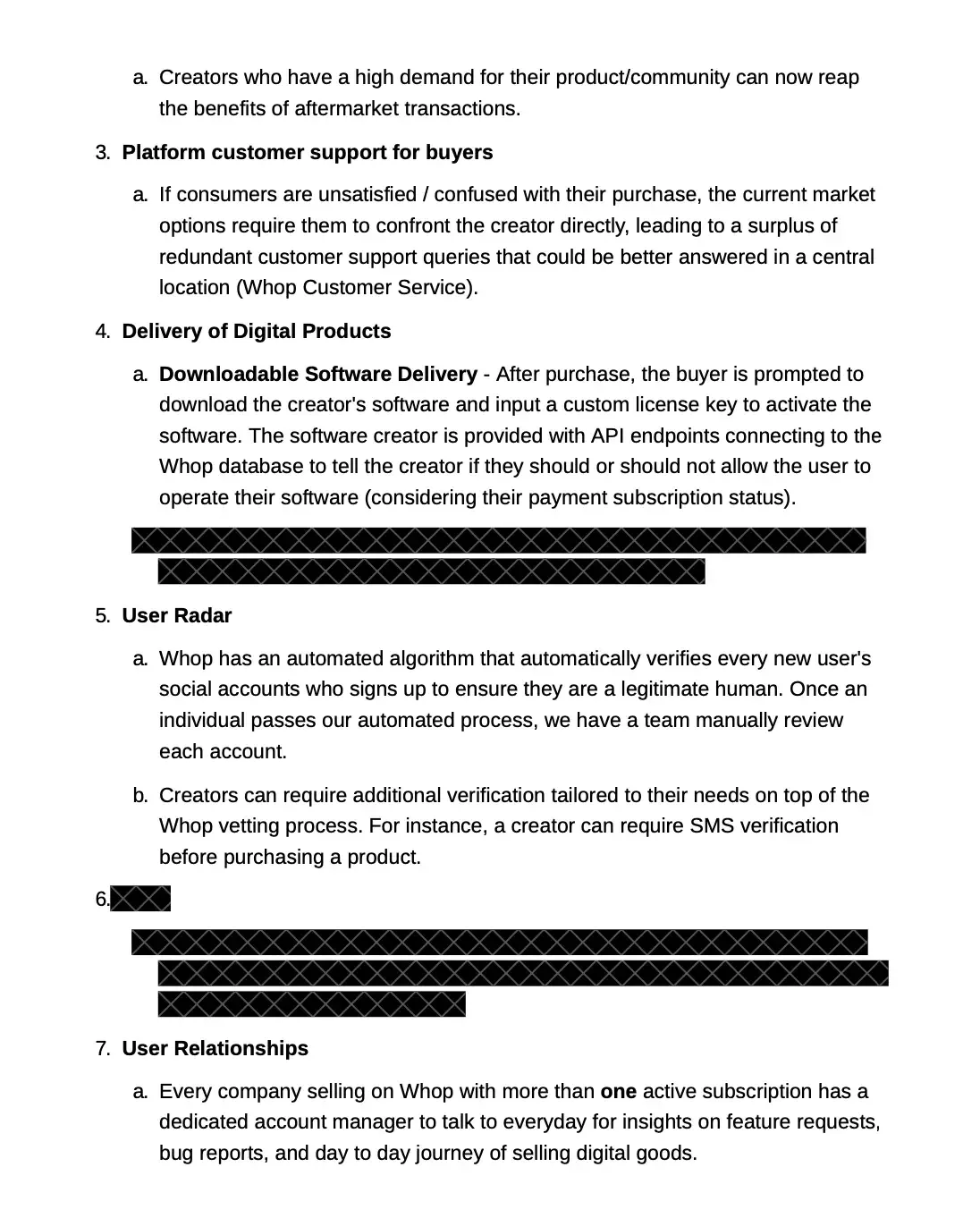
2. Aftermarket. Creators who have a high demand for their product or community can now reap the benefits of aftermarket transactions. 3. Platform customer support for buyers. If consumers are unsatisfied or confused with their purchase, the current market options require them to confront the creator directly, leading to a surplus of redundant customer support queries that could be better answered in a central location (Whop Customer Service). 4. Delivery of Digital Products. Downloadable Software Delivery: after purchase, the buyer is prompted to download the creator's software and input a custom license key to activate it. The software creator is provided with API endpoints connecting to the Whop database to tell the creator whether to allow the user to operate their software, considering their payment subscription status. 5. User Radar. Whop has an automated algorithm that verifies every new user's social accounts on signup to ensure they are a legitimate human. Once an individual passes the automated process, a team manually reviews each account. Creators can require additional verification tailored to their needs, for instance SMS verification before purchasing. 7. User Relationships. Every company selling on Whop with more than one active subscription has a dedicated account manager to talk to every day for insights on feature requests, bug reports, and the day to day journey of selling digital goods.
Observation · not investment advice
What this slide does
“Competitive advantages: delivery, support and trust” gives the deck a concrete product claim. 2. Aftermarket. Creators who have a high demand for their product or community can now reap the benefits of aftermarket transactions. 3. Platform customer support for buyers. If consumers are unsatisfied or confused with their purchase, the current market options require them to confront the creator directly, leading to a surplus of redundant customer support queries that could be better answered in a central location (Whop Customer Service). 4. Delivery of Digital Products. Downloadable Software Delivery: after purchase, the buyer is prompted to download the creator's software and input a custom license key to activate it. The software creator is provided with API endpoints connecting to the Whop database to tell the creator whether to allow the user to operate their software, considering their payment subscription status. 5. User Radar. Whop has an automated algorithm that verifies every new user's social accounts on signup to ensure they are a legitimate human. Once an individual passes the automated process, a team manually reviews each account. Creators can require additional verification tailored to their needs, for instance SMS verification before purchasing. 7. User Relationships. Every company selling on Whop with more than one active subscription has a dedicated account manager to talk to every day for insights on feature requests, bug reports, and the day to day journey of selling digital goods. Its job is to make that part of the argument easy to grasp before the narrative advances to the next point.
Member analysis
Go beyond the extracted text.
See how each slide advances the argument and turn the pattern into a reusable takeaway. The source slide text remains public above.
Similar slides
More product examples.
Useful public examples ranked by slide type, stage, industry, and shared text. Paid plans add semantic analysis.


